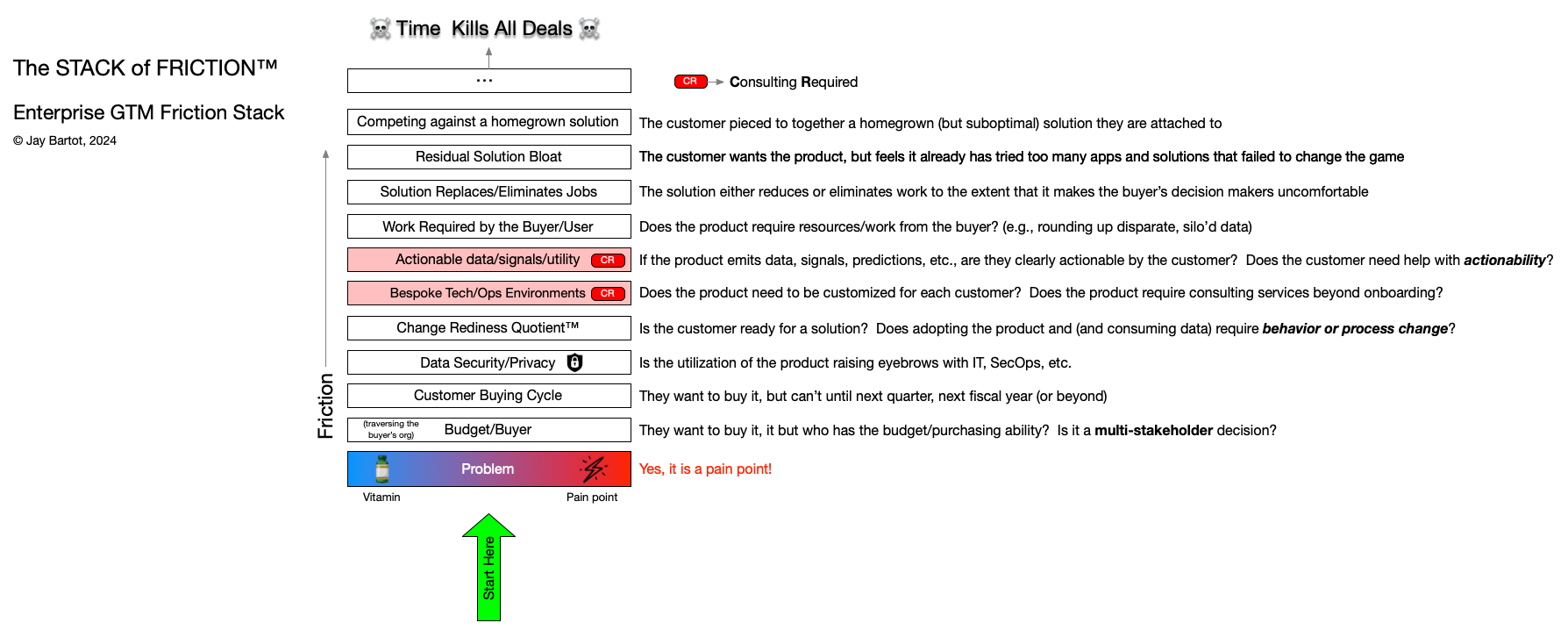
What is the Enterprise Stack of Friction?
The Enterprise Stack of Friction™ is a depiction of the layers of complexity and resistance that entrepreneurs can encoounter selling into enterprise organizations. Many of these layers are unknown and a surprise to entrepreneurs. They learn the hard way in their initial GTM motion that these layers, depending on which they encounter and in what order, can slow down the acquisition of customers dramatically. The main point is not that the layers are insurmountable, but rather that getting through them can take much longer than an entrepreneur would like or aniticipate. Many startups die not because they are not solving a real painpoint with a great product, but they did not budget their burn rate adequately to account for the time it takes to close the first few deals. They simply run out of time and money.
Description
The diagram starts at the bottom with the green arrow pointing upwards. The first layer is the litmus test of whether the startup product is a addressing a real priority painpoint. Remember that enterprises have lots of pain in many different areas. Does your solution solve a high-priority painpoint that pressing right now? Be careful that painpoints can come in and out of focus. You may engage with a an early customer when the painpoint you;re solving is pressing. But then, after dealing for months with various layers of friction, you almost get to the finish line only to learn that a recalibration of priorities took place and your painpoint is not longer a top priority to solve.
Key Concepts
- Time kills all deals. Time is not the friend of the seed-stage entrepreneur. The longer a deal is in the works, the more likely it will die. One reason for this is employee turnover at the customer's organization. Typically there is a champion working with the startup that believes the solution is a needed remedy to the problem at hand. The champion is also likely actiing out of more than the good graces of their heart and the well-being of their employer. They probably believe solving a big problem with an outside solution will bring them political capital. Of course, they are also risking political capital by taking a risk on your startup. The bottom line is if your champion leaves the company, you go back to square one and have to start all over. The lesson is do whatever you possibly can in your power to get deals done as soon as possible.
- People behavioral psychology. People don't like change.
Implications
- Accept early on that everything will take longer than you plan or want it to. You think it will take 3 months to get 3 customers. But what if it takes 9, 12 even 18 months?